|
If any word is underlined, you can click on to get more detail. Click on the photo to enlarge it and see more photos if available.
| Make |
Rhodes |
| Model |
Rhodes Chroma |
| Description |
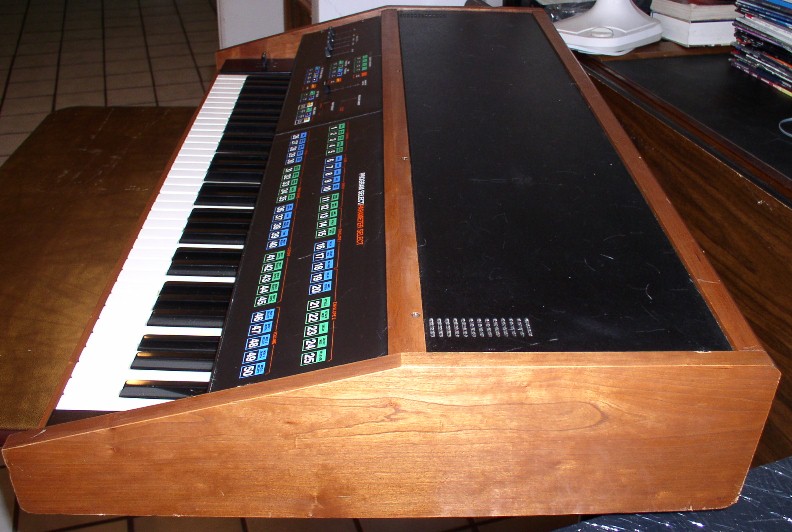
RARE RHODES CHROMA ANALOG POLYPHONIC SYNTHESIZER
Very rare and hard to find vintage analog synthesizer, particularly in this condition. Beautiful wood end pieces and trim. Serial number is #21010243.
The Chroma signalled a radical change in design policy for polyphonic synths, by dispensing with all the knobs and most sliders, and using serial parameter access instead. The Moog Source was the first monosynth to do this, and I believe the Chroma was the first poly. The DX7, for example, didn't come out until 1983. Unfortunately, the slider (with a curious mechanical solenoid 'thumper' telling you each time you hit another step) was not as
good a device even as the Source's wheel. (The thumper could be disabled if you didn't like it.)
It also beat the DX7 to another dubiously friendly innovation: algorithms. That might be a questionable virtue, but it more than makes up for it with its sound. It's said that having a separate signal path for each of its eight voice pairs means no possibility of phase-locking. Each of the VCOs is running free, and sounding richer because of it. I don't honestly understand this, but the Chroma certainly does sound rich.
Thanks to its good keyboard (specially designed for it), it's a pleasure to play, once you've sorted out your
sounds.
Patch and parameter selection is by touch membrane switches, reminiscent of those seen on the ARP Quadra.
Fifty are available, doubling as program numbers 1-50, and parameter selectors :-
Five for basic CONTROL, including 8/16 voice selection, sync and ring mod, filter mode (parallel or series),
keyboard note priority, arpeggios, de-tuning, etc.
Two for GLIDE - portamento / glissando.
Five for SWEEP (LFO control, including all of 16 waveforms and 16 modulation sources;
Six and seven for the two ENVELOPES respectively - ENV2 has an extra 'delay' control.
Seven for PITCH, including three independent modulation sources and amounts.
Four for WAVE SHAPE - basically pulse-width controls.
Nine for CUT-OFF (filter controls including three independent modulations,and notch and band pass filter selection).
Five for VOLUME - with loads of choices for modulating the VCA.
Resolution of the different parameters varies from eight steps to 128.
As well as the large two-digit LED program display, there's a small 8-digit DATA READOUT display.
Another radical feature of the Chroma was the computer interface - originally to the Apple II, and then,
theoretically, to the PC (which amazingly enough came out after the Chroma). It's quite likely that the
PC interface never went into production, though. The Apple version was very powerful for the time, including
probably the first computer sequencer ever, with 64 tracks, real-time playing, punch-in and -out, and
detailed event editing. Remember that this was pre-MIDI (MIDI became available as a retrofit for the
Chroma a year later - using the machine's computer socket). The Chroma was the first synth to be
able to transmit velocity information - a major step forward.
Other features included the ability to assign patches to different outputs (or use the outputs to insert effects);
program the function and polarity of performance sliders / levers for each patch;
and use a pedal to advance to the next patch (in a programmable sequence) during a performance.
Keyboard split was programmable - again a radical departure for the time.
The back panel has the 25-pin parallel computer socket (potentially so much better than MIDI's serial socket,
but there we go..), twin XLR outs, high and low level mono jack outs, sockets for two footswitches and two pedals, cassette in/out via DIN socket, and four jack 'AUDIO INPUTS / OUTPUTS'. It also has the memory protect switch
for programs.
There are two performance levers to the left of the keyboard, more like Oberheim or Yamaha levers than
Moog wheels.
The 34cm-long weighted wooden keys give it a real couch of class, its cherry end-cheeks add to the charm, and its modulation possibilities, while not in the Xpander class, are still impressive.
To help this synth communicate with anything other than an Apple II or a Polaris (or other Chroma /
Chroma Expander) you need a MIDI interface. This ARP Chroma comes with the J L Cooper
ChromaFace MIDI Interface.
Keyboard: 64-note
Programs: 50
External storage: Cassette interface, 100 programs
Polyphony: 16-voice
Oscillators per voice: 2
Effects: 3-band EQ
Connections: 4 mono audio, two XLR, MIDI [with retrofit]
Dimensions: 1000 mm x 576mm x 144mm
Weight: 32kg
Stellar synth company ARP crashed to earth in 1981, midway through the design of this instrument
Both ARP and the Chroma were then picked up by CBS Musical Instruments and branded with the name of Rhodes.
The Chroma looks innocent enough, but it is a complex and intriguing instrument, offering a level of parameter interplay you'd expect only from an earlier, completely modular design coupled with a level of sophistication (velocity sensitivity and a direct computer tie-in) that you'd expect on an instrument five years down the line.
This was never, and indeed still is not, a synth for novices. In the right hands, it is capable of stunning subtlety and richness of texture. In the wrong hands, it'll simply get the user lost and bored.
The Chroma was one of the first synths to implement a form of digital access control (i.e., doing away with
panel knobs and switches). It was also way ahead of its time in its ability to interface directly with an Apple IIe computer to run its own sequencing software and patch librarian.
Part of the reason for the Chroma's fearsome programming reputation is the fundamental freedom you are offered in terms of signal flow, namely, that you can choose from some 16 basic routing configurations to start with.
The level of flexibility runs through most of the modules: The oscillators can choose from a 1-63 value mix of sawtooth variable pulse waveforms and the filters are switchable between highpass and lowpass; there are 16 modulation sources for oscillator modulation, 16 LFO waveforms... This can be daunting enough at the best of times, but the
Chroma makes it worse by failing to name individual parameters on its control panel. Two rows of pressure-sensitive pads double as patch select and parameter select switches, and you must either simply remember that pad number 13, say, governs envelope amount based on key velocity or glue the parameter table to the top of the instrument. The display merely shows numbers.
Idiosyncratic though it is, the Chroma, nonetheless, found many friends in the upper echelons of keyboard
life during the early 1980s, most prominently Peter-John Vettese, who used the instrument extensively during his high-profile stint with Jethro Tull. The Chroma was a newsworthy axe to be seen with due to its sexy link with Apple computers (one of the first planned marriages of computer and keyboard), which spawned dedicated Chroma software for sequencing and patch librarian duties. The Interface Kit opened the door to 16-track sequencing with punch-in/out recording and selective track quantizing--pretty sophisticated for the time. A PC package was also produced.
Creditably, the regular keyboarded version makes a very decent stab at keyboard dynamics, a feature that
was not high on, or possibly not even on, most designers' lists at the time. The action on this quirky 64-note keyboard is pleasantly weighted and, with some 256 velocity levels, sensitive.
This ARP Chroma analog polyphonic synthesizer is in excellent condition, and is fully functional.
This auction includes the ARP Chroma synthesizer, footpedals, the JL Cooper ChromaFace MIDI Interface,
and a photocopy of the original brochure, operation manual, service manual with schematics, and computer interface / programming guide.
|
|
| Age |
22 year |
| Weight |
32 kg |
| Condition |
Near mint |
| Location |
Usa |
| Vat |
Not from a VAT-registered business. But VAT / duty may be due if importing from outside your trade bloc. |
| Quantity |
1 item is available from the owner |
| Options |
User manual : Yes |
| |
Service manual : Yes |
| |
First owner : No |
| |
Original boxes : No |
| Plug type |
Usa standard plug |
| Voltage type |
Internal 110 to 220-240V switchable |
| Status |
Item is still available |
| Sale type |
The item is for sale |
| Category |
|
| Serial number |
21010243 |
| Sphere reference |
# 3213 |
| Statistics |
Created on : 08/11/2003 |
|
Changed on : 15/11/2003 |
| |
Published on : (Not published) |
| |
Displayed : 1208 time(s) by members and guests |
| Safety |
All electrical items sold in VEMIA are deemed to be trade sales. No warranty of electrical safety is given or implied. Many items are vintage and would not pass current electrical safety standards. It is the responsibility of the buyer to ensure that items are safe to use in their future environment - if necessary by using the services of a professional. |
|
|
|
|
|
|
|
|
|
Prices and conditions  |
 top top |
|
|
|
The following section gives you the prices as well as shipment and payment conditions associated with the item. Payment is always requested in gear owner local currency. Converted price is shown for information and converted with Sphere standard currency rate.
Shipment and Payment links gives you access to an extended description of our rating :
| Price |
1733 USD |
| Converted price (1) |
1304.53 GBP |
| Shipment |
International or local shipment to pay |
| Packing costs |
n/a |
| Payment |
Full pre payment needed |
| Warranty |
n/a |
| Counter offer |
The bargain allows counter offers |
| (1) Currency conversion |
Note that conversion rates were last adjusted on 10th October 2025 at 14:22 CET. They are there to give you a rough guide to the bid price in your currency. Please check for a more up-to-date conversion at https://www.x-rates.com/calculator.html. The bid price will be the actual price in pounds (GBP) at the moment the auction closes. This will be roughly converted to your currency for your information.
For technical reasons, we are unable to update the conversion from GBP to Euro during the auction, although it may change at any time. If you are in the euro zone please check the current rate at https://www.x-rates.com/calculator.html
Payments must always be in GBP. For more info please see the FAQ about exchange rates.https://spheremusic.com/Winfaq.asp?Question=91. |
|
|
|
|
|
|