|
If any word is underlined, you can click on to get more detail. Click on the photo to enlarge it and see more photos if available.
| Make |
Moog |
| Model |
Sonic Six |
| Description |
MOOG SONIC SIX SYNTHESIZER
The Sonic Six is an old, simple, and rather interesting machine. It's an outgrowth of Moog's expansion in the
early seventies, when it took over a smaller company called Musonics, which made a synth called the Sonic V.
Moog took the Sonic V design, updated it with more Moog-like features (S-trig, three-stage Minimoog-like envelopes, etc) and released it as the attache-case-mounted Sonic VI.
It is an early duophonic portable synthesizer. It has some modulation capabilities not found in other small Moog models, and the sound...due to the odd filter design...actually has more in common with something like the Oberheim SEM modules. However, rather simple VCA envelope and VCF filter sections make this an easy synth for any user.
Not commonly seen, they were actually rather durable devices and used ones generally (if proper care was
taken of them) are found in good working order. It was designed for home use so it is light and portable and
has a built in amplifier and speaker. It has been used by Freddy Fresh, Stereolab and Spectrum/EAR.
The Moog Sonic Six is a 2-VCO duophonic synthesizer with a built-in speaker and a 4-octave, 49-note (C-C)
keyboard. Each VCO can output sawtooth, triangle, and rectangle (pulse/square) waveforms as well as
2 'waveform generators.' A 'quality' knob adjusts the width of the rectangular waveform. White or pink noise
is also available. The Sonic Six can be set for 3 keyboard modes; high note priority, low note priority, or
duophonic. The Sonic Six can also be set to an alternate tuning across the keyboard (different interval
between octaves of the keyboard). Portamento rate is controlled by a knob. The envelope section features
a basic envelope, with variable control for attack and decay and a switchable release (follows decay) and
sustain. It had a single VCF, low-pass voltage controlled filter. Two multimode LFOs are available. Their speed is independently variable and can be controlled by the envelope.
Technical Info
Polyphony Duophonic (2 Voices)
Oscillators 2 VCO's (sawtooth, triangle, square, pulse)
LFO (2) multimode LFO's with variable rate
VCF 1 low pass filter
VCA Attack / Decay / Sustain or Release
Keyboard 49 note keyboard
Control CV / Gate
Date 1974
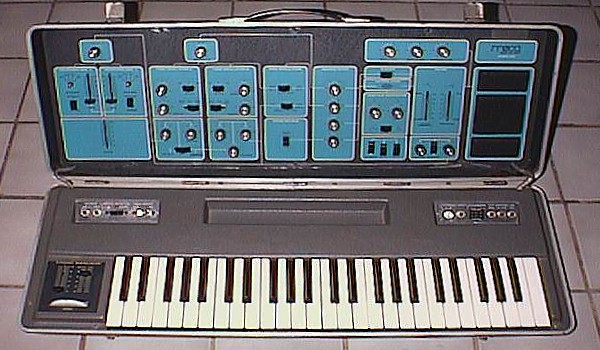
When you open it there's a 4-octave keyboard in the lower half and the control panel in the lid.
The panel is laid out, left to right, as follows:
Generator X/Y
Tone A/B
Mixer
VCF plus Contour
Articulator
Speaker
Apparently this machine was intended for use as a portable educational tool for teaching the principles of music synthesis. Names for the synthesizer functions are used that were 'easier to understand' than the cryptic terminology that synthesists use:
LFO X/Y
VCO A/B
Mixer
VCF plus Envelope Generator
VCA
Speaker
There is a single AD/AR (switchable) that is shared by everything. Among the less common features are:
* Voltage-controlled LFO's
* Duophonic keyboard
* Microtonal scaling adjustment for VCO tracking of the keyboard
* Real (not EXOR gate) ring modulator with mic pre-amp
* Direct output mixer so the VCOs can bypass everything
And for the circuit-mongers out there:
* Elevated chip temperature exponential VCO's
* Moog ladder filter (3046-based)
* 3080 VCA's (2 in series, 1 for envelope, 1 for final out ala Minimoog)
* Moog hi-frequency oscillator resistor divider keyboard (ala Micro, Multimoog)
The LFO's can be summed together and then their CV's can be linked to a single master rate pot, which makes for some cool modulation effects that you can speed up or slow down without changing the mod pattern.
There are CV and gate inputs (traditional Moog 1V/octave and S-trig) as well as inputs for VCF cutoff, master volume, and an external audio signal (with built-in pre-amp). This unit is probably best used for
processing external signals or sitting there in drone mode making spacey noises.
The duophonic mode can be used to good effect though, and the floating pitch wheel does great pedal steel effects.
|
|
| Age |
28 year |
| Weight |
10 kg |
| Condition |
Good |
| Location |
Usa |
| Vat |
Not from a VAT-registered business. But VAT / duty may be due if importing from outside your trade bloc. |
| Quantity |
1 item is available from the owner |
| Options |
User manual : Yes |
| |
Service manual : Yes |
| |
First owner : No |
| |
Original boxes : No |
| Plug type |
Usa standard plug |
| Voltage type |
Internal 110 to 220-240V switchable |
| Status |
Item has been sold or not sold in a previous auction |
| Sale type |
The item is on the auction rooms |
| Ending on |
15/11/2003 |
| Category |
|
| Serial number |
1234 |
| Sphere reference |
# 3190 |
| Statistics |
Created on : 05/11/2003 |
|
Changed on : 05/11/2003 |
| |
Published on : 05/11/2003 |
| |
Displayed : 1340 time(s) by members and guests |
| Safety |
All electrical items sold in VEMIA are deemed to be trade sales. No warranty of electrical safety is given or implied. Many items are vintage and would not pass current electrical safety standards. It is the responsibility of the buyer to ensure that items are safe to use in their future environment - if necessary by using the services of a professional. |
|
|
|
|
|
|
|
|
|
Prices and conditions  |
 top top |
|
|
|
The following section gives you the prices as well as shipment and payment conditions associated with the item. Payment is always requested in GBP. Converted price is shown for information and converted with Sphere standard currency rate.
Shipment and Payment links gives you access to an extended description of our rating :
| Start price |
840 USD |
| Converted price (1) |
632.32 GBP |
| Shipment |
International or local shipment to pay |
| Packing costs |
n/a |
| Payment |
Full pre payment needed |
| Auction bid step |
20 GBP |
| Auction highest bid |
513.08 GBP |
| Converted highest bid |
513.08 GBP |
| Leader or winner |
fartoogood |
| (1) Currency conversion |
Note that conversion rates were last adjusted on 10th October 2025 at 14:22 CET. They are there to give you a rough guide to the bid price in your currency. Please check for a more up-to-date conversion at https://www.x-rates.com/calculator.html. The bid price will be the actual price in pounds (GBP) at the moment the auction closes. This will be roughly converted to your currency for your information.
For technical reasons, we are unable to update the conversion from GBP to Euro during the auction, although it may change at any time. If you are in the euro zone please check the current rate at https://www.x-rates.com/calculator.html
Payments must always be in GBP. For more info please see the FAQ about exchange rates.https://spheremusic.com/Winfaq.asp?Question=91. |
|
|
|
|
|
|